Overview
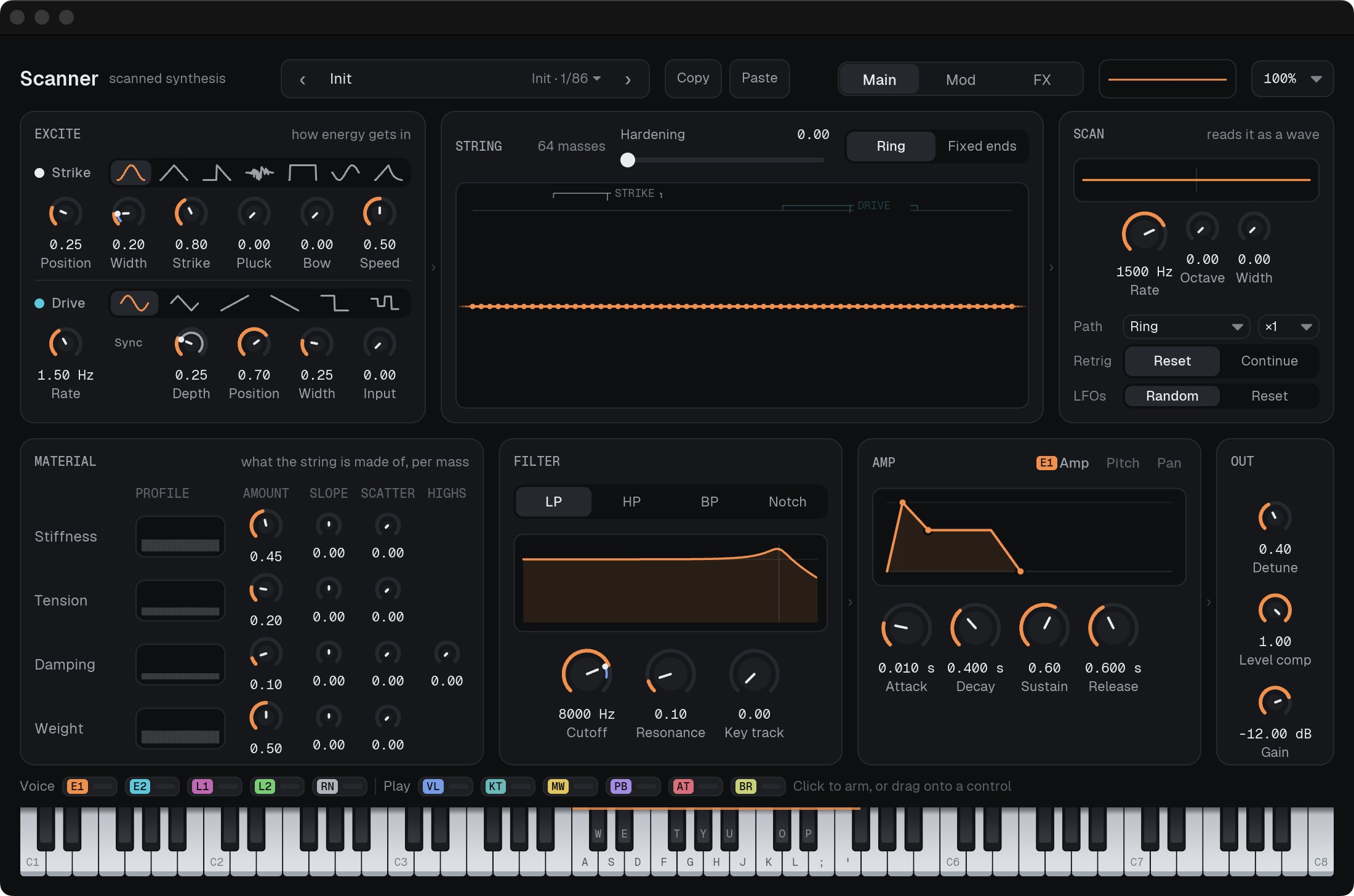
Scanner is a scanned synthesis instrument. Every voice owns a small physical object: 64 masses joined by springs into a ring. You strike it, pluck it or bow it, and it wobbles. A separate scanner runs around the ring at the pitch you play and reads the shape as a waveform.
The ring moves slowly and the scanner reads it fast, so pitch and timbre come apart. The keyboard sets the note. The physics sets the sound. Because the object is actually moving, the waveform keeps changing in a way an oscillator can't fake.
The controls feel more like picking a material than tweaking a synth. Stiffness, tension, damping and weight each have a slope across the ring and a random scatter per mass, and that's where the character comes from. Even ring and it's a clean tone. Uneven ring and it's a detuned bell, a sheet of metal, or broken glass. You can also feed audio into the sidechain and let the ring resonate with it.
Credits
- Bill Verplank, Max Mathews and Robert Shaw, "Scanned Synthesis", 2000. The paper that introduced the technique, and the source of the mass-spring ring, the slow-chain/fast-scanner split and the advice to keep the chain uneven.
Features
- 64-mass spring chain per voice, as a closed ring or with fixed ends like a string.
- Strike, pluck and bow the chain, with seven strike shapes and a stick-slip bow that sustains the note.
- Drive LFO to keep pushing the chain while a note is held, with its own position, width, shape and tempo sync.
- Sidechain input: feed any audio in and the chain resonates with it.
- Material physics: stiffness, tension, damping and weight, each with slope and scatter for uneven, inharmonic objects. High-frequency damping and hardening for sounds that darken as they ring and brighten when hit hard.
- Scan rate from 0.05 Hz to 5 kHz: low rates make the wave morph slowly, high rates bring out the modes.
- Scan paths (ring, fold, interleave, scramble) with stride, a stereo width that reads two points on the chain, and a sub-octave tap.
- Live chain display showing the masses, springs, strike and drive zones. Hover a knob to see its per-mass values.
- Six filter models (SVF, Ladder, Diode, MS-20, OTA, CMOS) with LP, HP, BP and Notch modes and key tracking.
- Level compensation so physics changes alter the tone, not the volume.
- 8-slot mod matrix with two envelopes, two tempo-syncable LFOs with delay, velocity, key track, mod wheel, pitch bend, aftertouch and random. Modulate the physics itself and the material shifts under the sound.
- Distortion, chorus, delay and reverb on the master bus.
- 86 factory presets, from basses, keys and bells to drones and atmospheres.
- Copy and paste whole patches as text.
Changelog
Releases
-
First release of Scanner, a scanned-synthesis instrument: a ring of 64 masses and springs that you strike, pluck, bow or drive, read back as a waveform.
Effects rack
- Filter, distortion, chorus, flanger, delay, reverb and a five-band EQ, each with its own On switch and Mix in the chain list.
- Drag effects to reorder the chain; click one to edit it.
- Delay, chorus and flanger rates can sync to the host tempo.
- Drag the EQ curve's nodes to shape it.
Modulation
- Click a source to arm it, then drag any knob to set its amount, or click a knob to add or remove the source.
- Knobs show a live dot where modulation puts them.
- Routings support a via source (for example mod wheel × LFO), polarity flip and bypass.
- The effects can be modulated too.
- Mod wheel, aftertouch, breath (CC 2) and expression (CC 11) are supported.
- Vel Sens and Vel Curve set how hard you need to play.
Presets
- Every preset comes with routings for velocity, the mod wheel and aftertouch.
- Search by name, type or character tag.
- Browse with the arrow keys; Esc returns to the sound you started from.
Fixes
- Re-hitting a note in Continue mode no longer clicks.