Overview
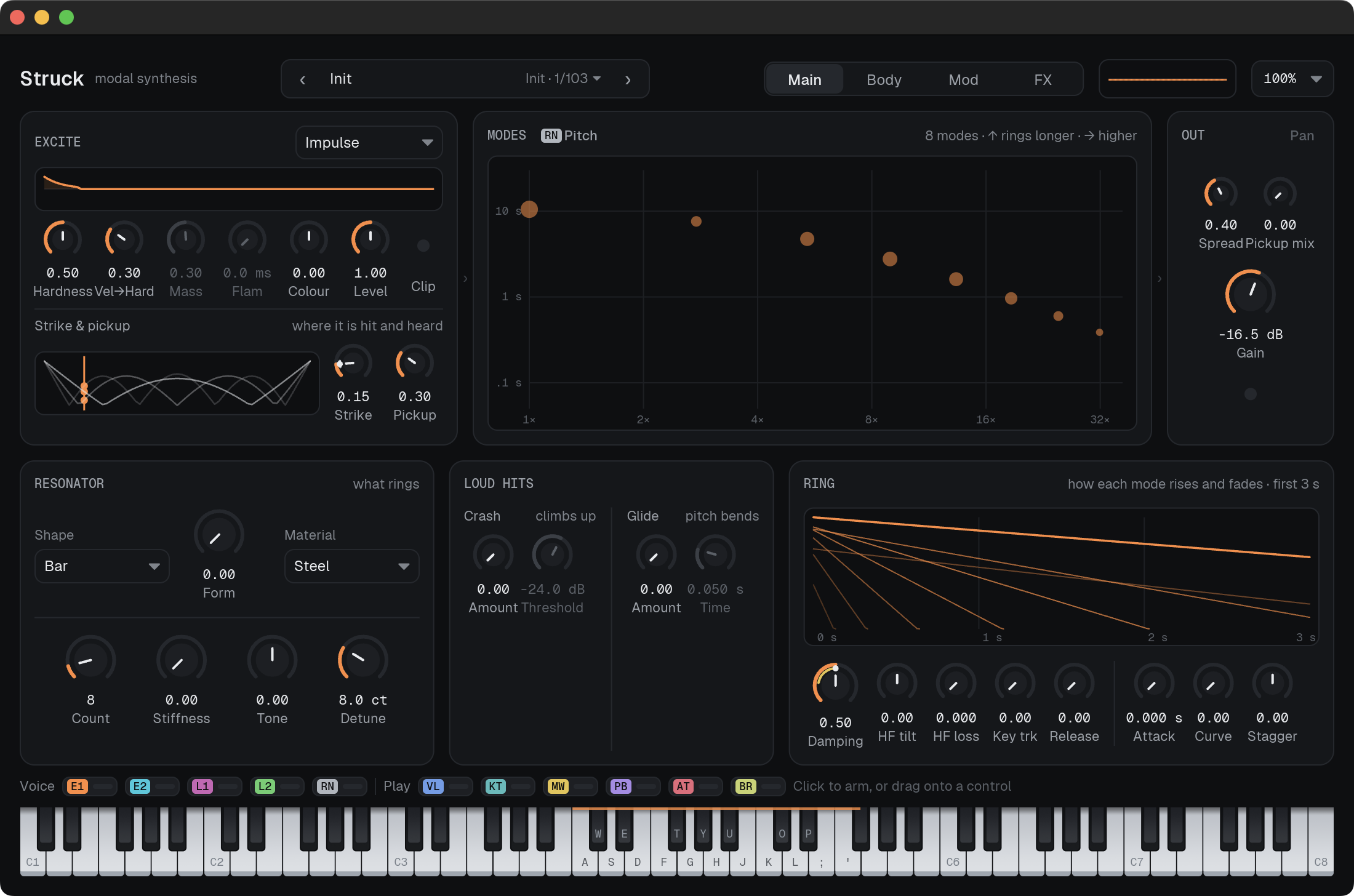
Struck is a modal synth. Real objects ring at a set of frequencies, called modes, and Struck plays those modes directly. You don't pick an instrument from a list. You pick a shape, a material, how you play it and where you touch it, and the instrument comes out of that.
A wooden bar hit with a mallet is a marimba. Make the bar glass and it's something else. Bow a bronze bowl and it sings. Blow into a tube and you get a clarinet-ish reed. Any shape works with any material, so a wooden bell or a glass string is just two clicks away.
The exciters are physical too. A bow locks to the pitch, a mallet bounces off, a pluck pushes then slips. Hit a gong hard and it blooms brighter. Hit a drum hard and the pitch bends. The Modes plot shows every mode as a dot, so you can see what each control does to the sound while you turn it.
Credits
Struck draws on decades of research into how real instruments vibrate. The main sources:
- Neville Fletcher and Thomas Rossing, The Physics of Musical Instruments. Mode frequencies for strings, bars, plates, bells and bodies.
- Julius O. Smith III, Physical Audio Signal Processing, and Perry Cook, Real Sound Synthesis for Interactive Applications, 2002. Modal synthesis and feedback combs.
- Max Mathews and Julius O. Smith III, "Methods for Synthesizing Very High Q Parametrically Well Behaved Two Pole Filters", SMAC-03, 2003. The resonators behind every mode.
- M. E. McIntyre, R. T. Schumacher and J. Woodhouse, "On the oscillations of musical instruments", JASA 74(5), 1983. The bow and reed.
- Stefania Serafin, The Sound of Friction, PhD thesis, CCRMA, 2004, and Avanzini, Serafin and Rocchesso, IEEE TSAP 13(5), 2005. Bowing and scraping.
- K. H. Hunt and F. R. E. Crossley, "Coefficient of restitution interpreted as damping in vibroimpact", J. Appl. Mech. 42, 1975, and F. Avanzini and D. Rocchesso, "Modeling Collision Sounds: Non-Linear Contact Force", DAFx-01, 2001. The mallet.
- Cuzzucoli and Lombardo, Computer Music Journal 23(2), 1999. The pluck.
- Aramaki, Besson, Kronland-Martinet and Ystad, IEEE TASLP 19(2), 2011, and Chaigne and Lambourg, JASA 109, 2001. How each material damps its modes.
- Touzé and Bilbao, Physica D 280, 2014, and Avanzini, Marogna and Bank, JASA 131(1), 2012. Crash and pitch glide on loud hits.
- Karjalainen and Smith, "Body Modeling Techniques for String Instrument Synthesis", ICMC 1996. The body resonator.
- Jaffe and Smith, Computer Music Journal 7(2), 1983. Tuning the Karplus-Strong loop.
Features
- Eight exciters: impulse, mallet, pluck, bow, scrape, reed, air and noise. Bow, scrape, reed and air sustain while you hold the key.
- Ten shapes with a Form control that morphs each one through its family: string, bar, tine, membrane, plate, disc, bowl, bell, tube and steelpan.
- Eight materials: steel, bronze, glass, wood, plastic, nylon, skin and stone.
- Up to 64 modes per voice, with stiffness, tone tilt and per-note detune.
- Strike and pickup position: hit a string in the middle and the even harmonics vanish, just like the real thing.
- Loud-hit behaviour: Crash makes hard hits bloom brighter, Glide makes them start sharp and settle.
- Ring controls for damping, high-frequency loss, key tracking, a damper on key-up, attack and stagger. The sustain pedal works like a vibraphone damper.
- Body resonator (wood, metal, glass, card or tube) to colour the sound.
- Feedback loop that sends the output back into the object, with filters, drive and a frequency shifter for combs, Karplus-style strings and barber-pole sweeps.
- Modes plot that shows every mode and explains each control as you hover it.
- 8-slot mod matrix with two envelopes, two LFOs, velocity, key track, mod wheel, pitch bend, aftertouch and random. Route an LFO to Form and the object morphs as it rings.
- Low cut, distortion, chorus, delay and reverb on the FX page.
- Over 100 factory presets.
Changelog
Releases
-
First release of Struck, a modal synthesizer: strike, pluck, bow or blow a bank of resonant modes shaped like bars, strings, plates, bowls and tubes.
Effects rack
- Filter, distortion, chorus, flanger, delay, reverb and a five-band EQ, each with its own On switch and Mix in the chain list.
- Drag effects to reorder the chain; click one to edit it.
- Delay, chorus and flanger rates can sync to the host tempo.
- Drag the EQ curve's nodes to shape it.
Modulation
- Click a source to arm it, then drag any knob to set its amount, or click a knob to add or remove the source.
- Knobs show a live dot where modulation puts them.
- Routings support a via source (for example mod wheel × LFO), polarity flip and bypass.
- The effects can be modulated too.
- Mod wheel, aftertouch, breath (CC 2) and expression (CC 11) are supported.
- Vel Sens and Vel Curve set how hard you need to play.
Presets
- Every preset comes with routings for velocity, the mod wheel and aftertouch.
- Search by name, type or character tag.
- Browse with the arrow keys; Esc returns to the sound you started from.
Playing
- Switching presets stops the previous sound.
- Soft keys still start reed instruments.
- Bowed sounds respond to velocity evenly at every pitch.
- The output low cut moved into the rack EQ.